Slicing a pizza the mathematician way
There's no limit to creativity. Maybe time, but it still tends to infinity. Therefore it has no limit either.
What about pizzas? Well, pizzas can have a limit. You slice it traditionally in $S = 1, 2, 4, 8, 16, \ldots, n$ slices or as an alternative, cut it into segments. It's not very common to encounter a pizza sliced in segments outside Latin America. However, one day an online challenge brought to my attention the question of slicing a pizza into three equal parts, defining only two segments.
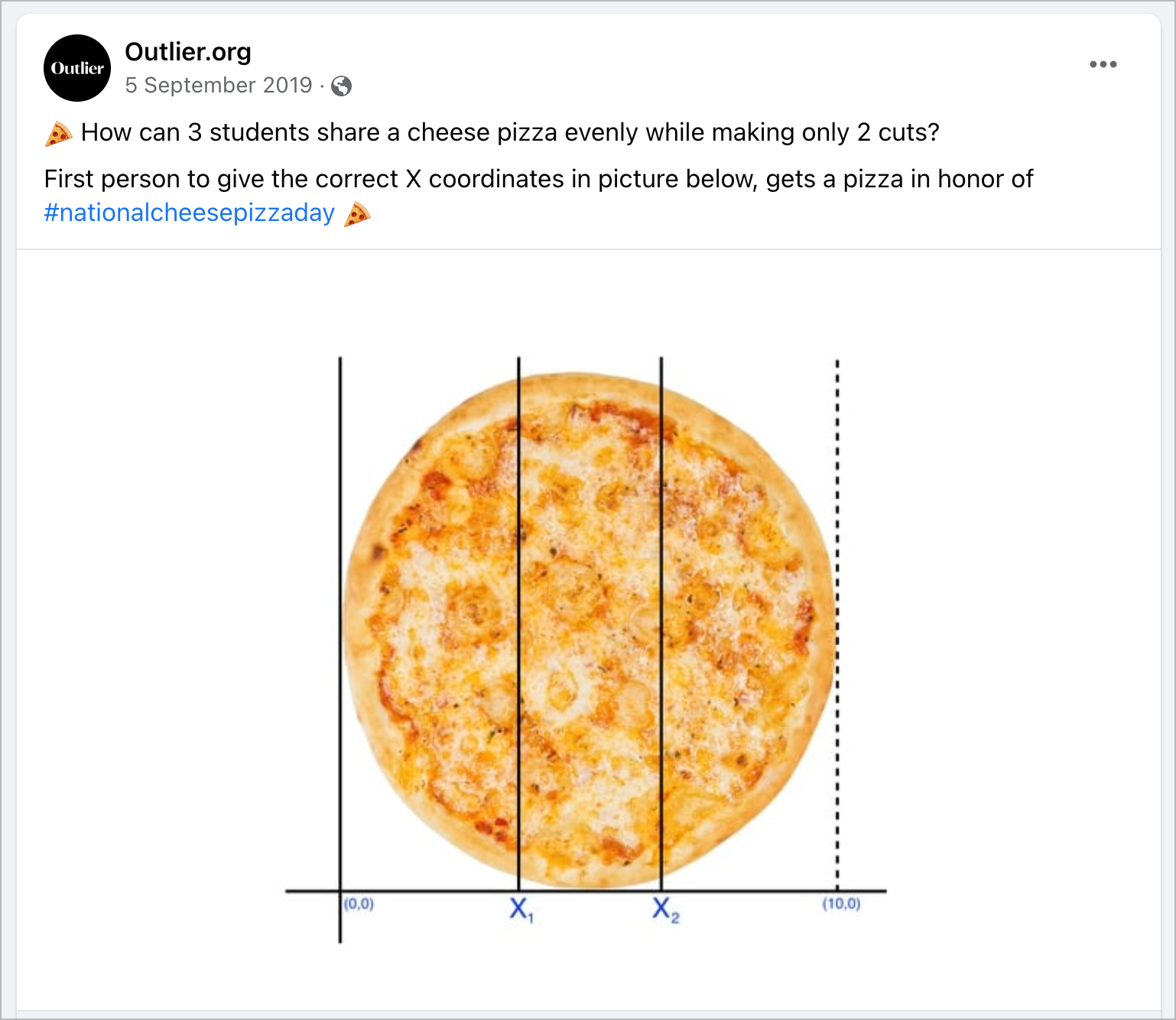
The way the graphic indicates induces the assumption that answers should be towards creating segments with the proposed $x_1$ and $x_2$ cuts and if you want to work this problem out, you'll probably reach the proposed solution. Not without scratching your head recalling your geometry and trigonometry knowledge. The solution is $x_1 = 3.675$ and $x_2 = 6.325$.
That is a solution, for sure. However, imagine using the same approach if you continue and slice the pizza in even more parts. You're probably wondering how can we deal with the even more complicated arc calculations that are necessary to define the cuts proportionally.
So, what is the alternate way, then?
During my high school years, I've stumbled across a slightly peculiar mathematics book. It was written in Spanish, smelly, and filled up with fading pencil page notes. I've tried to remember the book name for years, but nowadays I'm sure that it was a translation for Kiselev's geometry book1. Prof. Alexander Givental2 adapted the Russian original text into two volumes: Kiselev's Geometry Book I. Planimetry3 and Book II. Stereometry4. The Spanish version I had access to, was probably a donation from some engineer who worked at the Itaipu Dam in my home city.
However, until that point in my life, my relation to mathematics leaned towards fiddling with equations until I stumbled in the right answer, which matched the answers sheet. I had no idea what a mathematical proof or anything in the regular undergrad toolbox was. So I approached the problems, always repeating the same pattern. Trying out the exercises in this book was the recipe to hit several frustrating roadblocks as it contained a series of increased complexity exercises. There's a point beyond a certain complexity level the math I knew wasn't enough to find an answer.
One exercise in this book was presented similarly as the initial question above, and whenever I see some disk this pops back on my mind.
- Construct a disk equivalent to a given ring (i.e., the figure bounded by two concentric circles)
- Divide a disk into $2,3 \ldots n$ equivalent parts by concentric circles.
The first part was quite easy to solve. Following the descriptive geometry approach which the book suggests, you draw two concentric circles and shade the area between them. I used to hate this, but nowadays I see it correlates a lot with programming.
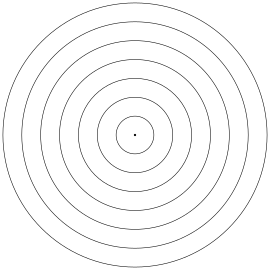
Now with the second part, and as you may have guessed at this point, it can be used to solve the proposed question above. There's one catch, as when it says equivalent parts, it's talking about the area as the follow-up exercises require this assumption.
Now we should solve the problem out to find the proportionality between the radii and the number of partitions. The naively wrong approach would assume we can divide the radius into $n$ parts as the picture above, and the problem would be solved. Unfortunately, that's not that straightforward as the areas would be different.
Prof. Carlos, was not my actual teacher but enjoyed a good conversation and a challenge. He was mentoring me out of my mathematical misery. He gave me books, problems, and steered me in the right direction. Not always, as he also gave me misdirected hints to see if I was not distracted from the problem. I still remember the day we solved this puzzle. He introduced me to several concepts I'd only fully understand later in my studies as induction, series, limits, and integration.
Back to the problem. Let's outline our facts:
- Let the radius of the outer circle be $R = r_n$
- The area of a circle is $A = \pi R^2$
- Let the radii of the concentric circles be $r_0 < r_1 < \ldots < r_{n-1} < r_n = R$, where $r_0 = 0$ is the center
We want each ring to have equal area $A = \frac{\pi R^2}{n}$ and find the radii that satisfy this.
It's probably not a surprise to you that the ring-shaped object is the region bounded by two concentric circles has a name, and it's called Annulus5. Furthermore, the area of an annulus is the difference in the areas of the larger circle of radius $R$ and the smaller one of radius $r$. I won't enter the realm of calculus at this moment, but this can be achieved using Polar integration6, and that would blow up my initial argument that the first solution was verbose.
Given $A_{annulus} = \pi\left(R^2 - r^2\right)$
$A_0 = \pi \cdot 0$
$A_1 = \pi(r_1^2-r_{0}^2) = \pi r_1^2$
The area of a ring as the difference between itself and its inner concentric circle as $A_i = \pi(r_i^2-r_{i-1}^2)$
We want to make $A = \pi(r_i^2-r_{i-1}^2) + \pi(r_{i-1}^2-r_{i-2}^2) + \ldots + A_0$
Arranging this equality in a series form, $\pi R^2 = \pi [ (r_n^2-r_{n-1}^2) + (r_{n-1}^2-r_{n-2}^2) + \ldots + r_1^2 ]$. This is a telescoping sum, the intermediate terms cancel, leaving $R^2 = r_n^2$. Now, if we require each ring to have equal area $\frac{\pi R^2}{n}$, we get $r_i^2 - r_{i-1}^2 = \frac{R^2}{n}$, which gives us $r_i = R\sqrt{\frac{i}{n}}$ where $n$ is the number of rings.
Presto! We found a way to express the radius as it shrinks toward the inner circle. Therefore, you can easily slice a pizza with radius R by n persons slicing it in the function of this.
So now you're thinking this solution is pretty neat, and that we should write some code to split the pizza between our peers fairly.
import math

def slice_area(disk_radius, rings):
    return math.pi * (disk_radius * math.sqrt(1 / rings)) ** 2

def disk_inner_radius(disk_radius, rings, ring):
    return disk_radius * math.sqrt(ring / rings)

def disk_inner_radii(disk_radius, rings):
    return [disk_inner_radius(disk_radius, rings, i) for i in range(1, rings + 1)]
note that we should consider rings as integers and areas as float.
But, wait a minute. Can you slice a pizza this way?
Although this method seems mathematically fair, I had intentionally left the final result of the disk partitioning until now to avoid spoiling out the surprise. Take a look as the outer ring thickness seems to shrink as the radius increases. Odd but correct.
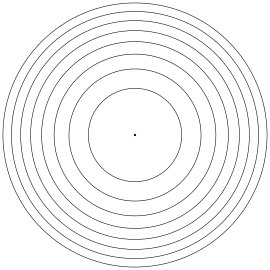
The derivation above shows all the rings have the same area, which means the same amount of pizza. However, as we increase the division, the outer rings become thinner, leaving you with a tiny edge slice compared to the center. Good luck trying to handle the outer ring.
Using the code we wrote, we can check that indeed, all the areas have the same size in a radius 10 disk with 8 rings.
rings area: [39.26990817 39.26990817 39.26990817 ... ]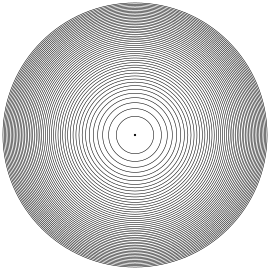
Can we use this for something else?
Well, the first thing that comes to my mind is to fix weather and blast radius representations. I've seen countless times reporters commenting that the area of some natural damage is twice as previously estimated because it was within a radius $X$ and now we're at radius $2X$. Now you know that's not true, doubling the radius quadruples the area.
The same $R^2$ relationship shows up everywhere. A bomb's blast energy dissipates with the square of the distance, the inverse square law. A LIDAR sensor with twice the range covers four times the area, which matters quite a bit when you're reasoning about detection probability in self-driving cars. And sound intensity follows the same rule: double your distance from a speaker and the intensity drops to a quarter. Music, bombs, and self-driving cars, all the same pizza problem in disguise.
Mathematical modeling often requires creativity as much as it requires a good toolset. The pizza problem started as a geometry puzzle, but the moment you recognize the $R^2$ scaling, the same idea clicks into place across domains you wouldn't expect. Having the right tools, telescoping sums, annulus areas, a bit of algebra, lets you move from intuition to a clean result. But it's the willingness to look at a pizza and see a sensor coverage problem that gets you there in the first place.
Appendix: what's the fanciest way to slice a pizza?
It starts with the broad question, can we cut a flat disk into equally sized pieces with some not touching the center?
The researchers demonstrated that it is possible to cut a flat disc into scythe-shaped, curved slices with any odd-number of sides, known as 5-gons, 7-gons, 9-gons. The paper describing the solution is named Infinite families of monohedral disk tilings7
A nice youtube video can help us visualize the solution better.
A. P., Kiselev, Elementary geometry. For secondary schools. With the application of a large number of exercises and articles
A. P. Kiselev, Alexander Givental, Kiselev's Geometry, Book I. Planimetry 2006
A. P. Kiselev, Alexander Givental, Kiselev's Geometry, Book II. Stereometry, 2008
Infinite families of monohedral disk tilings - https://arxiv.org/abs/1512.03794